
Manual Configuration
The Visualizer plugin allows you to add a manual configuration to the charts.
1. Navigate to the Visualizer > Chart Library.
2. Open one of the existing charts or create a new one.
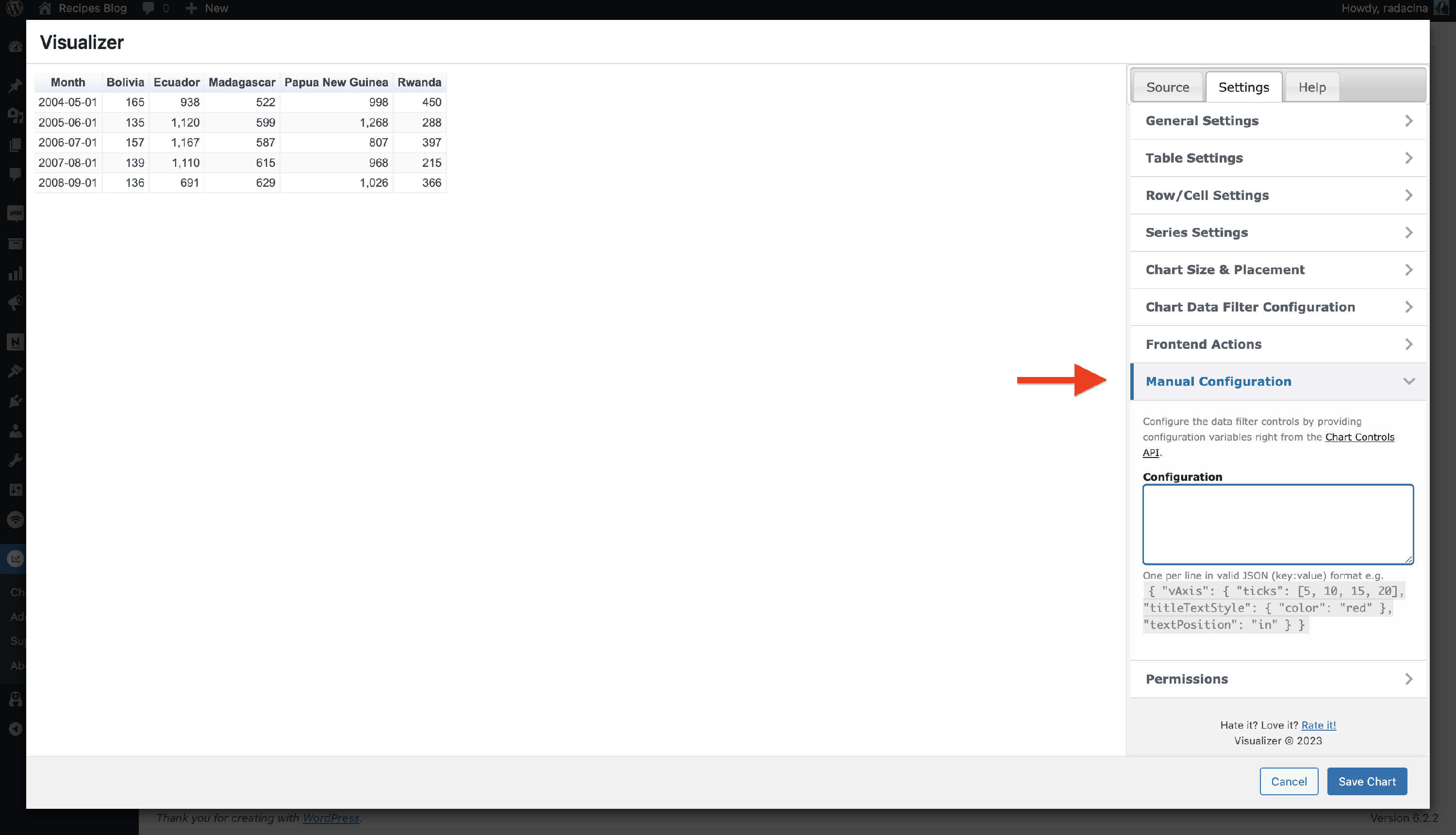
3. Switch to Settings > Manual Configuration.
4. Paste the desired code snippets from below according to the type of chart that you use.
In this article
Google Charts
Create dual Y-axis
Supported charts: Area, Bar, Column, Combo, Line
- The below code will convert the first and second series into Y axis.
{
"vAxes": {
          "0": {"title": "Temps (Celsius)"},
          "1": {"title": "Daylight"}
        },
"series": {
          "0": {"targetAxisIndex": "0"},
          "1": {"targetAxisIndex": "1"}
        }
}- The below code will convert the first and second series into Y axis and customize the ticks on each axis.
{
"vAxes": {
          "0": {"title": "Temps (Celsius)", "ticks": [1500000, 2000000]},
          "1": {"title": "Daylight","ticks": [15000, 2000]}
        },
"series": {
          "0": {"targetAxisIndex": "0"},
          "1": {"targetAxisIndex": "1"}
        }
}
Customize Axis
Supported charts: All except Pie, Gauge, and Table.
- The below code will change the angle of the text to 90 degrees. Make it 0 if the text needs to be horizontal.
{
"hAxis": {
         "slantedTextAngle": 90
        }
}
If your horizontal (X) axis labels are truncated, cut off, or shown as
..., follow Horizontal axis labels are truncated or cut off in Visualizer for the complete fix path.The below code will change the ticks of the X-axis.
{
"hAxis": {
         "ticks": [10,20,30,90]
        }
}- The below code will change the maximum and minimum value of the Y axis without changing the data.
{
"vAxis": {
	"maxValue": 20,
	"minValue":-1
	}
}
Customize Pie Charts
Supported charts: Pie
- The below code will change how the "Other" slice works. In the default pie chart that the plugin creates, we will combine all slices that have a value of 16% and below into one slice.
{
	"sliceVisibilityThreshold": 0.16
}- Change the size of the pie hole in a donut chart and the text color so that the values are visible.
{
	"pieHole": 0.9,
	"pieSliceTextStyle":{
		"color":"red"
	}
}
Customize Gauge Charts
Supported charts: Gauge
- Change major ticks in the gauges. Provide as many strings as the number of ticks required.
{
	"majorTicks": ["tick one","tick two","tick three"]
}
Customize Text/Font
Supported charts: All except Gauge and Table.
- Change font family and font size for all text.
{
	"fontName": "Verdana",
	"fontSize": 10
}
Customize Tooltip
Supported charts: All except Gauge and Table.
- Enable HTML tooltips so that you can style them.
{
	"tooltip": {
		"isHtml":"true"
	}
 }
Add this code to the theme CSS file.
div.google-visualization-tooltip {
	/* style the tooltip here */
}
Customize Stacked Charts
Supported charts: Bar, Column.
- 100% stacked
{
	"isStacked": "percent"
}- 100% stacked, fractional
{
	"isStacked": "relative"
 }
When creating a Combo chart, the number format field is only available in the Horizontal axis settings but not in the Vertical axis settings.
This code will help users to set up a manual configuration so the number format field will also be available in the Vertical axis settings.
{ "vAxis": { "format": "#%" } }Save the changes and see if the number format is now available in the Vertical axis settings.
Change the baseline value from 0 to something else in the Combo chart
{"vAxis": {
    "baseline": 40
}}
Remove the shaded area(area opacity) in the combo chart
{"areaOpacity": 0}You can specify the chart type and color of each series for the combo chart
{
  "series": {
    "0": {"targetAxisIndex": 0, "type": "bars", "color": "#1f77b4"},
    "1": {"targetAxisIndex": 0, "type": "bars", "color": "#ff7f0e"},
    "2": {"targetAxisIndex": 1, "type": "line", "color": "#2ca02c"}
  }
}
ChartJS
Customize Radar Charts
Supported charts: Radar/Spider
- Customize the size of the data point labels in the Radar chart.
{"scales": {
    "r": {
      "pointLabels": {
        "font": {
          "size": 16
        }
      }
    }
  }}
Customize Pie Charts
Supported charts: Pie / Donut
- Go from Pie to Donut chart:
{
   "cutoutPercentage": 50
}
This will add a Donut Hole in the center of your Pie chart, turning it into a Donut. The value 50 is the percentage of the whole Pie chart, which will be transformed into a hole. You can customize that value according to your preferences.
- Set the rotation value
The rotation for a ChartJS Pie chart is defined as the angle from which the arcs will start showing.
{
   "rotation": 45
}
The difference can be observed from the arcs positioning.
- Customize the Pie / Donut circumference:
{
   "circumference": 6
}
This value is automatically multiplied by PI. If the value is too low, the chart will not be able to form a complete circle. If the value is too high, the chart will spin until it matches the circumference you set through this code. Here is an example of such extreme cases:
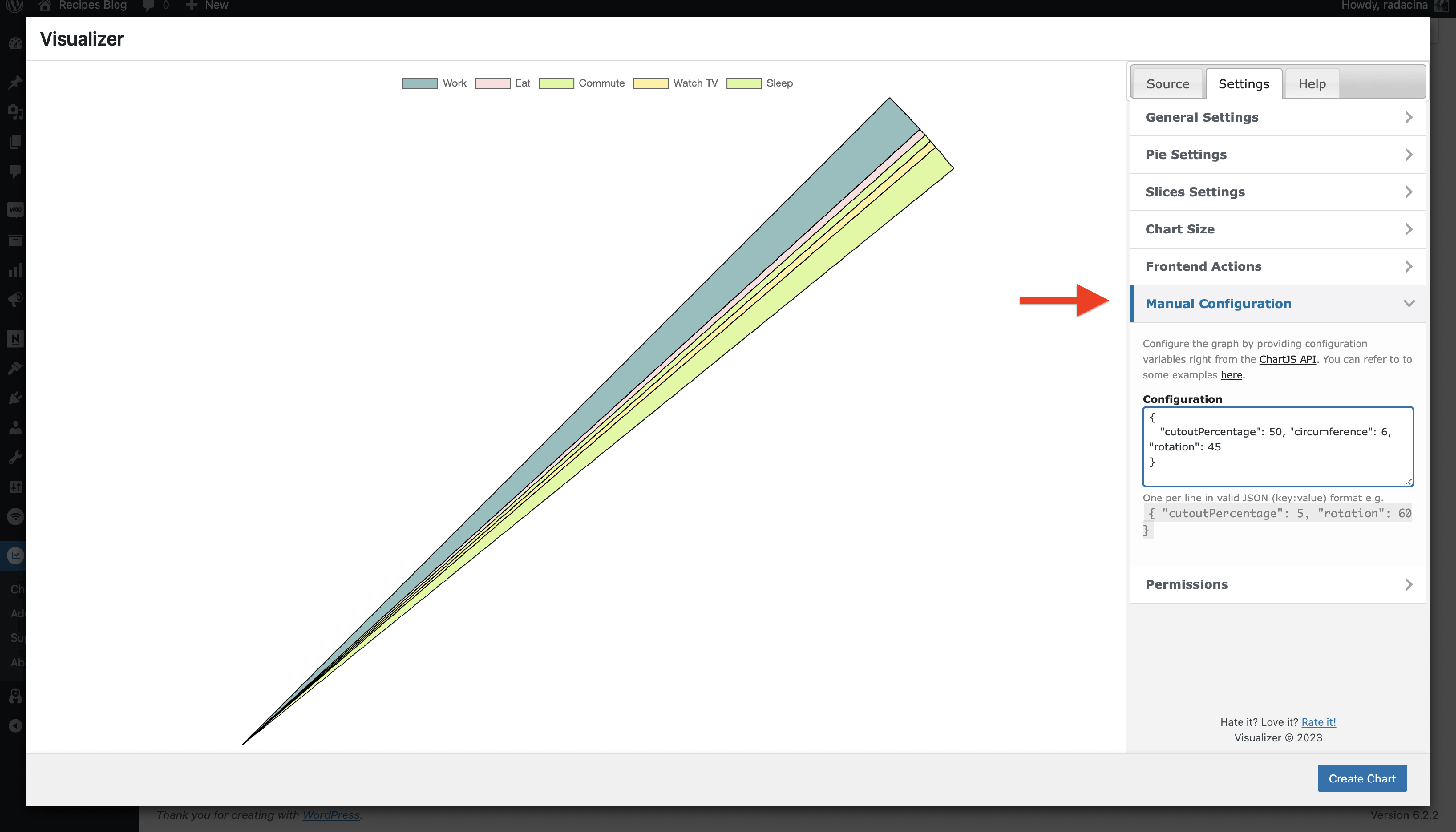
All the snippets from above can, of course, be combined and used on the same Pie Chart at once:
{
   "cutoutPercentage": 50, "rotation": 45, "circumference": 6
}
Customize Line Charts
Supported charts: Line
- Disable / Hide the Lines that connect the dots:
{
   "showLines": false
}
The default value here is true. By changing it to false, the lines will disappear, but the ticks (dots) will remain in place.
- Interrupt the lines if the data for a certain value is missing:
{
   "spanGaps": true
}
The default value here is false.
Disable the animations to improve website performance & speed
Supported charts: ALL
Chart animations, if they last long enough, might affect your page loading time and performance. If your charts have long render times, it is a good idea to disable animations. This will have the effect of reducing CPU usage and improving general page performance.
To disable animations, use this:
{
   "animation": false
}